Apr. 11 2025
Development of Film in Mary Is Happy, Mary is Happy: The Landscape of Thailand
I'm trying to predict the next five minutes.
—Mary Is Happy, Mary Is Happy 00:44:21
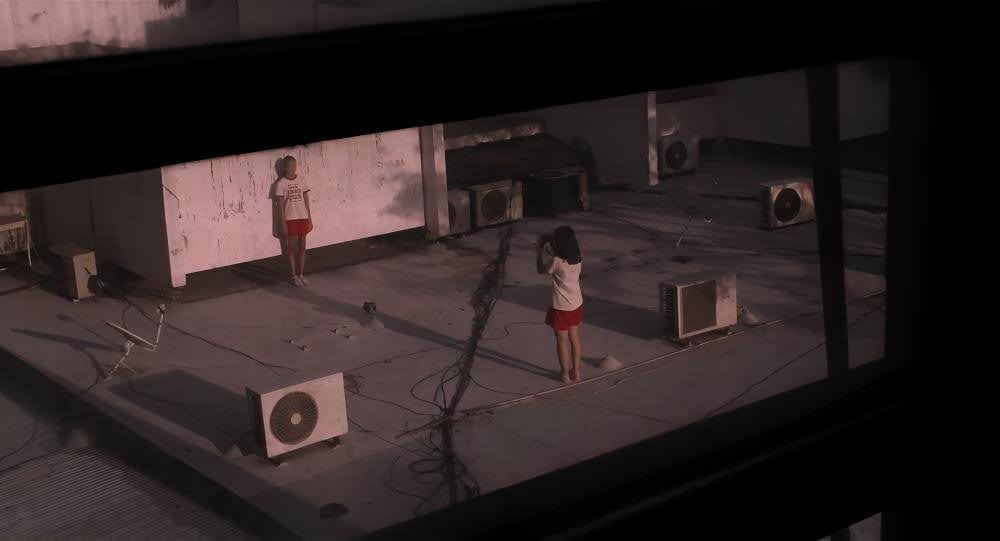
Still from Mary Is Happy, Mary Is Happy, directed by Nawapol Thamrongrattanarit, 2013. (1:26:58).
Nawapol Thamrongrattanarit's movie, Mary Is Happy, Mary Is Happy (2013) (henceforth referred to as Mary Is Happy) is an deceptively charming movie. Adapted from found tweets by @marylony on twitter, Thamrongrattanarit builds a narrative of a senior year highschool student named Mary Maloney who decides to create and photograph for a yearbook to remember all of her classmates before they all graduate and move away. In the process, her phone explodes three times, her best friend tragically dies, and she goes through the motions of a crush. At the same time, she witnesses her school usher in new powers that rid all students of their rights and redirect the curriculum to circle around details of the headmaster, but this is portrayed as more of a nuisance than anything.1
Taking from the framework of Sara Ahmed from her book, Queer Phenomenology, I focus on the use of the camera in Mary is Happy, and how it is used as a tool to create culture, especially in the landscape of Thailand. In Thailand's process to cement identity, three bodies (or as I will call them, photographers) are represented in this film: that of the artist (Mary), outside forces (most noticeably the west), and those currently in power (Thailand, as represented by the new Headmaster's regime, henceforth referred to as "the school"). In such a grand concept, its depiction of authoritarian forces is passive and is equal to (and sometimes less than) the emotions and duration of a crush. I am interested in what this says about the development of politics in Thailand and its surrounding area and how it is reflected in the culture that is produced.
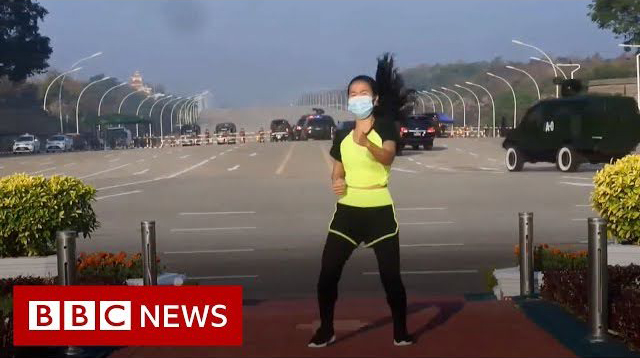
Still from "Myanmar fitness instructor accidentally captures coup unfolding - BBC News", BBC News, Youtube, 3 Feb. 2021, https://www.youtube.com/watch?v=yEHiTjViicE
To preface the framework I am analyzing the film in, I view the camera as a mechanism that creates culture and in its use, the photograph as culture (or at the very least, has the ability of being culture). The camera for the photographer acts similarly to a table for the philosopher. According to Ahmed, the object of a table plays a large role of orientation in the world of philosophy, "the use of tables shows us the very orientation of philosophy in part by showing us what is proximate to the body of the philosopher, or 'what' the philosopher comes into contact 'with.'" 2 Similarly, the camera acts as an eye for the photographer that records what is being orientated by its capture. It is less that the photographer is being orientated towards the camera, but through it. The camera becomes a tool that amplifies orientation. Ahmed writes "Groups are formed through their shared orientation toward an object."3 So, in the case of the camera, the photograph becomes the point of orientation and is therefore a point of culture.
The Camera Body in Cultural Production
For Mary, the effect of creating the yearbook is not necessarily as large as the other photographers later discussed. She wishes to capture images of her classmates to remember them by, not to urgently form culture on a larger scale. Because of this, Mary's working method with the camera is queer. It is wandering, slow, and subversive. Often times Mary is unable to meet deadlines and has nothing to show when asked: she presents a blank album after her jungle trip, she only takes yearbook portraits during "golden hour," when the sun sets, if "golden hour" has passed due to her own lateness, she postpones the event to the next day. If following the school's expectation of timeliness, style, and method is, as Ahmed references Maurice Merleau-Ponty, "vertical," then Mary as a photographer is "slanted."4 Because influence made by the west is so deeply concrete it is easy to begin to orient oneself towards it. It is almost as if it is omnipotent. In the case of Mary Is Happy, the influence of the west acts as a photograph that has been developing for years of exposure in the psyche of herself, her classmates, and more largely, the people of Thailand. Because the image of the west is so deeply ingrained, it feels hard to be able to pin why the pull is so strong other than the fact that it is. The references to the "global north" are substantial: texts in English (the student uniform reads "SCHOOL/1983/SPORTS DAY/THE SENIORS," reminiscent of bootlegged shirts that use the latin language as a stylistic choice, classes teaching English, as well as some of Mary's tweets), in reference to the culture around them ("believing" in obama, advice from French magazines), and it is also brought up as an escape from Thailand. Literally, many of Mary's classmates' bodies are directed towards the occident as they depart to schools in Europe to continue their schooling. Ahmed writes, "To become oriental is both to be given an orientation and to be shaped by the orientation of that gift." 5 The culture created by the western camera has contours that are crisp and are beautifully saturated and that's all the justification that feels needed.
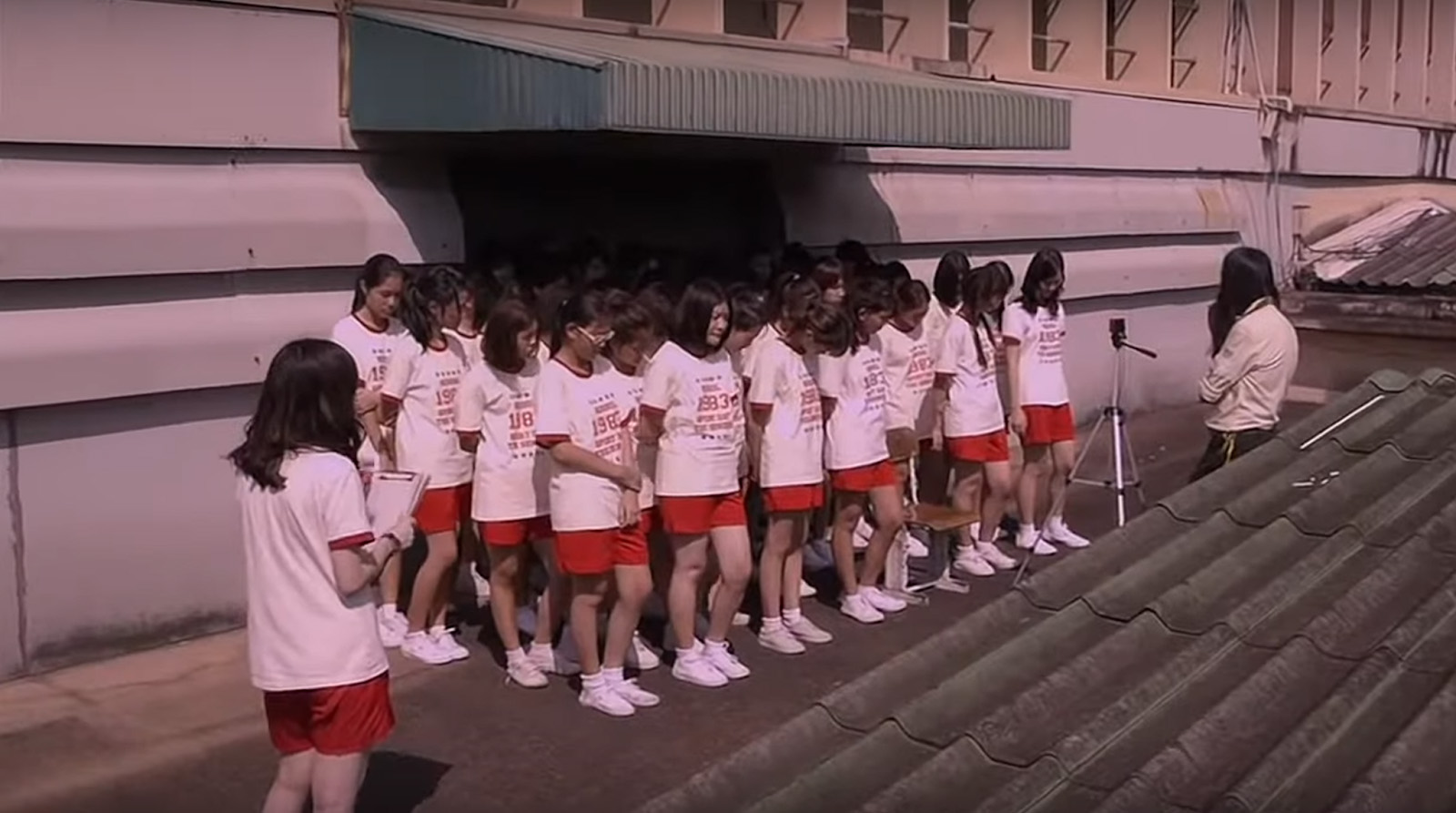
Still from Mary Is Happy, directed by Nawapol Thamrongrattanarit, 2013. (01:31:27).
How does a country combat these outside forces while it is in its process of instilling a national identity? If the school represents the national forces of Thailand, then it acts as a stand in to create Thai culture. While Mary is given permission to create her idea of a yearbook, she is slowly edged out of creative freedom for a controlled perspective that supplies the school with a better public image. In this low level panic to define culture, the school must actively suppress Mary's queer method of working for one that is forced, streamlined, and manufactured. Equally important to this fabrication of free will is the grace of the school to give her this opportunity to exercise it. Like Thai artists given a platform if they conform to national ideologies, Mary is being propped up by the school to be representative of the school's values. A part of Mary's experience with the school was being thrown outside in a dark cage for breaking the rule: "questions and opinions are forbidden,"6 so, through this process, Mary's camera becomes "vertical.". By the time she is asked to design the book cover, she is defeated and chooses a design that would be met with no resistance: a still life of a mangosteen fruit—the headmasters favourite. The appearance of Mary's camera is not visible, but it is sold as if the photograph happened naturally and willingly.
Mary Is Mary
While internally, the film tackles topics of western influence and dictatorial powers in the creation of culture, how is the video camera acknowledged and what does the product of film do in conversation with all of this? If a photograph is culture, so is film. Mary Is Happy is not purely a reflection of culture, but a site of cultural production too. The film does more than reflect the cultural tensions occurring in Thailand. Thamrongrattanarit synthesises that these tensions are what currently make Thailand. In the film's casual tone, it says to live in Thai culture is to continually watch a culture be manufactured while another is imported overseas. It is to be subtly but fully bear witness to being pulled outwards and redefined inside. The line between what is Thai/not-Thai is irrelevant. The landscape of this area is rapidly changing to be able to assess this anyway. When the orientation of Thai culture is to be constantly thrown in the air and disoriented, Thamrongrattanarit can only offer a snapshot. After Mary returns to her parents after graduation, she asks her mom when the mountains behind their home appeared. Her mom tells her "last week". 7
1 Throughout this paper, I refer to a subtitled version of Mary Is Happy, Mary is Happy and acknowledge discrepancies that occur when translating from Thai to English.
2 Sara Ahmed, Queer Phenomenology: Orientations, Objects, Others (Durham, NC: Duke University Press, 2006), 4.
3 Ahmed, Queer Phenomenology, 119.
4 Ahmed, Queer Phenomenology, 65.
5 Ahmed, Queer Phenomenology, 114.
6 Mary Is Happy, Mary Is Happy, directed by Nawapol
Thamrongrattanarit (2013),
00:38:32, sic.
7 Mary Is Happy, 02:02:01
Bibliography
BBC News, "Myanmar fitness instructor accidentally captures coup unfolding - BBC News," uploaded February 3, 2021 Youtube video, https://www.youtube.com/watch?v=yEHiTjViicE.
Thamrongrattanarit, Nawapol, dir. Mary Is Happy, Mary Is Happy. Thailand: GTH; Mosquito Films Distribution, 2013. Film.
Ahmed, Sara. Queer Phenomenology: Orientations, Objects, Others. Durham: Duke University Press, 2006